Working group
Anatolian Shepherd Dog
Also called Anatolian, Anatolian Karabash, Coban Kopegi
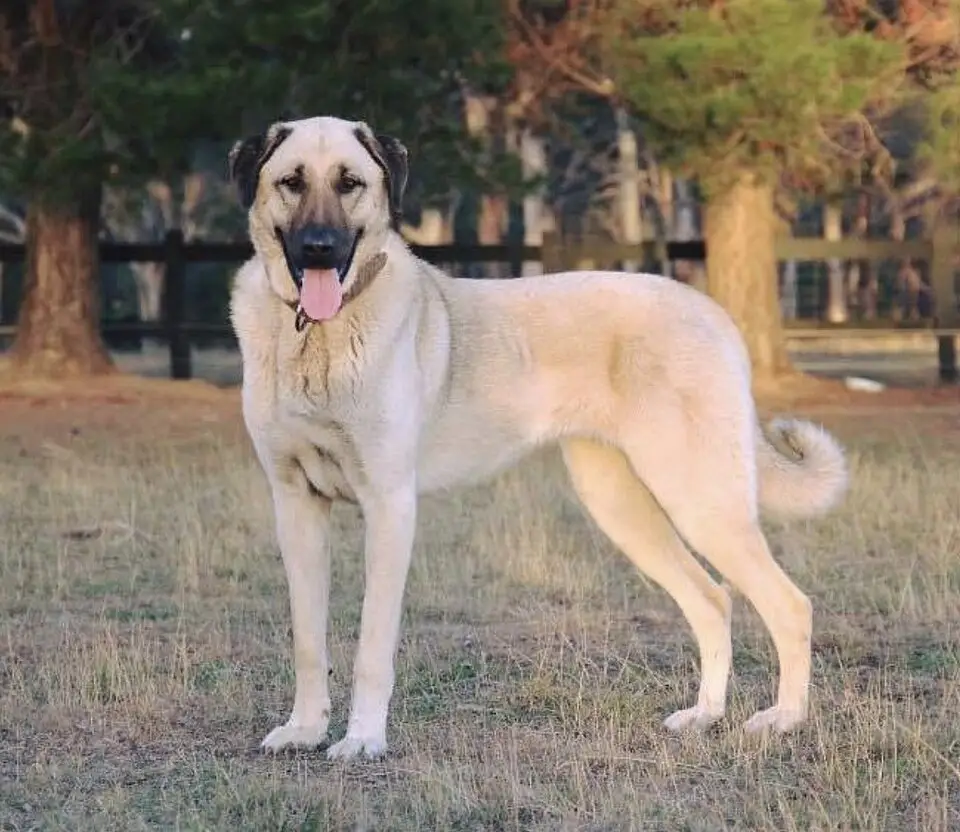
The Anatolian Shepherd Dog is a massive Turkish livestock guardian that stands 27 to 29 in (69 to 74 cm) and weighs 80 to 150 lb (36 to 68 kg). It is loyal and calm with its family but wary of strangers and independent-minded, so it needs an experienced owner, serious socialization and a very secure fence.
- Height
- 27–29 in (69–74 cm)
- Weight
- 80–150 lb (36–68 kg)
- Life span
- 11–13 years
- Size
- Giant
- Group
- Working
- Origin
- Turkey
- Coat
- Thick, short double coat (some have a longer outer coat)
Colors: Fawn, Brindle, Biscuit and white, Red fawn, White, Pinto
Great for
- Experienced owners of guardian breeds
- Rural properties or large fenced acreage
- People protecting livestock
- Owners who can invest in lifelong socialization
Think twice if
- First-time dog owners
- Apartment or small-yard living
- Homes with frequent visitors
- People who want an off-leash hiking companion
Traits at a glance
1–5 scale. For grooming, shedding, drooling and barking, 5 means more. For the “living with” rows, 5 means copes well.
Living with
- Apartment living
- Good for first-time owners
- Tolerates being alone
- Handles cold
- Handles heat
Personality
- Affection with family
- Good with kids
- Good with other dogs
- Friendly to strangers
- Playfulness
- Watchdog instinct
Care
- Grooming needs
- Shedding
- Drooling
- Barking
- General health
Energy & training
- Energy level
- Exercise needs
- Trainability
- Prey drive
Personality
Anatolians are serious, steady guardians. The AKC describes them as protective and territorial but also intelligent, patient and profoundly loyal, and they were bred to make decisions on their own while watching over a flock. That independence is the heart of the breed. An Anatolian does not wait for instructions before it decides that something is a threat.
With their own family, Anatolians are calm and affectionate. With outsiders, they are reserved and watchful. PetMD says they are wary of strangers, quick to react if they sense danger to the household or flock, and prone to barking at perceived threats, which matters if you have close neighbors.
The AKC says Anatolians protect their charges with intensity, whether that means livestock, children or smaller dogs. They can suit a home with older children who understand dogs, but PetMD cautions that the breed may not be right for families with small kids.
This is a dog for an experienced owner who can be a calm, confident leader. It is not a good choice for someone who wants a cuddly, eager-to-please pet.
History
Anatolia is the Asian part of Turkey, a high plateau of dry, brutally hot summers and bitter winters. Shepherds there developed a livestock guardian known as the coban kopegi, or "shepherd's dog", the forerunner of today's Anatolian. The AKC traces the breed's roots back some 6,000 years, and large dogs of similar type appear in Assyrian carvings dated to around 2000 BC.
The breed's story in America begins in the years before World War II, when the U.S. Department of Agriculture imported a breeding pair from Turkey for a sheepdog project that was disbanded when the war began. The modern U.S. breed took root in 1970, when Navy Lt. Robert Ballard, who had acquired two guardians while stationed in Turkey, bred his first litter at home. Those dogs became foundation stock for American breeders. The timing helped: new wildlife laws meant ranchers needed to protect livestock from wolves without killing them, and Anatolians tend to scare off predators rather than fight them.
The American Anatolian descends mainly from Turkish Kangal dogs, with some Akbash in the mix, and American breeders have allowed more variety in coat length and color than Turkish breeders typically do. Anatolians also guard livestock in Namibia, where the Cheetah Conservation Fund has placed them with farmers since 1994.
Appearance, coat & colors
Anatolians are large, muscular dogs built to cover rough ground. The AKC lists males at about 29 in (74 cm) tall and 110 to 150 lb (50 to 68 kg), and females at about 27 in (69 cm) and 80 to 120 lb (36 to 54 kg). Despite the bulk, they are nimble and quick on their feet.
The coat is a thick double layer. Most Anatolians have a short outer coat over a dense undercoat, while some have a longer outer coat. AKC colors include fawn in several shades, brindle, liver, white, and biscuit and white, and the breed standard treats all color patterns and markings as equally acceptable.
The AKC says the breed has a timeless, no-frills look, and the dogs trace back to some of the oldest known domestic-dog bloodlines. Heavy muscle gives the powerful frame needed to face predators and rough terrain.
Training
Anatolians are intelligent, but they were bred to work independently, so training them to follow commands is a challenge. The AKC says obedience training is a must, and that puppies must be socialized to a wide range of people, animals and situations. Because the breed is wary and protective by instinct, socialization is not a phase. It continues throughout life.
Use calm, consistent, reward-based methods. PetMD says the independence can look like stubbornness, and that the breed needs an experienced owner, consistency and positive reinforcement. Short sessions, clear rules and patience work better than force with a dog that outweighs many adults.
The AKC is blunt about one thing: under no circumstances should an Anatolian get protection or guard-dog training. The breed already guards by instinct, and adding aggression training makes a dangerous combination.
Start a puppy class early, while the dog is small enough to handle. Teach the basics, including come, sit, stay and loose-leash walking, and use a sturdy harness or collar for control.
Exercise
Anatolians do not need intense exercise. The AKC says a moderate amount is enough: time in a yard and a long walk once or twice a day. The yard must have a tall, strong fence and a locked gate. PetMD adds that playtime in a secure yard is often sufficient, and suggests activities such as farm work, walking and swimming.
Leash rules are strict. The AKC says an Anatolian must be on a leash whenever it leaves the home, and quotes a breeder who warns that assuming the dog will be reliable off-leash can lead to disaster. A livestock guardian may follow its own judgment when it sees something it considers a threat.
Mental stimulation still matters. Use daily walks, training and a patrolling job in a secure space. Our guide to how much exercise a dog needs explains how to match activity to age and ability.
Puppies of giant breeds grow quickly, so ask your vet how much exercise is appropriate at each stage.
Grooming
Grooming is straightforward but seasonal. The AKC says the Anatolian has a thick undercoat built for the elements, and most dogs have a short outer coat that needs a quick weekly brushing. PetMD says the breed sheds moderately all year.
Twice a year the undercoat comes out in a rush. During those shedding seasons, brush thoroughly every few days with a short-bristle brush and a comb to remove the dead hair, which will otherwise carpet your home. A deshedding rake can help with a dog this big.
Bathing is only needed when the dog is dirty or smelly. Check the ears regularly and clean them as needed, and especially after swimming or other water exposure, as PetMD advises. Keep watch on the eyes, too. Entropion, in which the eyelid turns inward and the lashes rub the eye, occurs in the breed, so have your vet check any eye that looks sore or irritated.
Brush the teeth often, and trim nails regularly. With a dog of 100 pounds or more, it pays to get your puppy comfortable with handling, nail trims and brushing early.
Feeding
Feed a high-quality complete and balanced diet for your dog's life stage, whether commercial or home-prepared with your vet's guidance. The AKC notes that the Anatolian does not tend to overeat, but treats still add up during training, so count them toward the daily total.
Giant dogs grow fast. Ask your vet whether a large-breed puppy formula suits your puppy and how quickly the weight should climb. Our dog food calculator can give an estimate for adults, but your vet should confirm it.
Deep-chested dogs can develop bloat, and PetMD lists gastric dilatation-volvulus as a risk for the breed. VCA names eating one large meal a day, eating rapidly and exercising after a big meal among the risk factors. Dividing the daily ration into two meals, slowing a fast eater and resting your dog after meals are sensible steps.
Provide fresh water at all times. Ask your vet about any supplements.
Health
The AKC calls the Anatolian overall healthy and hardy. It says hip dysplasia and bloat are not common in the breed, while PetMD lists elbow and hip dysplasia, entropion and gastric dilatation-volvulus (GDV) among the conditions to watch for. Breeders should screen hips and elbows, and good breeders also screen for entropion, in which the eyelid rolls inward so that the lashes rub the eye. Entropion can be surgically corrected.
GDV is an emergency. A swollen belly, unproductive retching, restlessness, heavy drooling, trouble breathing or collapse mean you should call your vet or an emergency clinic immediately. Our page on bloat and GDV explains the signs.
The AKC also says the breed can be sensitive to anesthesia. Make sure your vet knows the dog is an Anatolian before any procedure involving sedation. PetMD adds that recovery can take longer, so the team monitors them closely.
The AKC's health notes add that Anatolians love to chew and have strong jaws, so offer sturdy, appropriate chews. Life expectancy is typically 11 to 13 years.
Health conditions to know about
- Entropion — The eyelid rolls inward so lashes rub the eye; it can be corrected with surgery.
- Hip and elbow dysplasia — Joint malformation that can lead to arthritis; screening is recommended even though the AKC says hip dysplasia is not common.
- Bloat (GDV) — Deep-chested dogs can suffer a twisted stomach, which is an emergency; know the signs.
- Anesthesia sensitivity — The breed can be sensitive to anesthesia, so tell your vet before any procedure.
Health tests to ask a breeder about
- Hip evaluation
- Elbow evaluation
- Eye exam for entropion
Written from veterinary sources by the Pawsplained editorial team. Not yet reviewed by a veterinarian; this is general information, not a diagnosis or treatment plan. Updated Oct 30, 2026. Editorial policy
Living with a Anatolian Shepherd Dog
This is not a suburban pet. Anatolians are working guardians, happiest on acreage where they have a job and a secure boundary. The AKC emphasizes a tall, strong fence and a locked gate. Many are still ranch dogs that guard sheep, goats and other livestock.
They bark, especially at perceived threats, and a dog patrolling a fence line at night can be loud. PetMD says that can be a problem for neighbors. Plan for guests, delivery drivers and anyone who comes near the property, because the dog's wary nature does not turn off.
Anatolians generally get along with other pets if socialized young, according to PetMD, and they protect the family animals as part of the flock. Introduce new animals slowly.
With kids, the breed can do well in a home with older children who understand how to behave around a large dog. Supervision is mandatory, especially with visiting children, since a wary guardian may react to unfamiliar people.
Puppies, breeders & rescue
Finding an Anatolian puppy takes homework, because this is not a breed for impulse buyers. Prices vary widely, and a breeder who asks you plenty of questions is a good sign. Ask how the parents behave with strangers, other dogs and livestock, and whether they work or are show dogs. Meet the mother, and watch how she reacts to you.
The AKC lists hip and elbow evaluations as recommended screening, and good breeders also screen for entropion. Ask to see the results for both parents. A responsible breeder raises puppies in the home or on the working farm, starts socialization early, provides a written contract and takes the dog back at any age.
Be careful with sellers who always have puppies available or who offer large discounts. Because the American Anatolian comes from several types of Turkish guardian dog, puppies from different lines can differ in coat length and color.
Adult rescues can be wonderful but need an experienced home. Ask about the dog's behavior with strangers, other dogs and fences. Our breed selector can help you compare this breed with others.
Anatolian Shepherd Dog FAQ
How big do Anatolian Shepherd Dogs get?
Males stand about 29 in (74 cm) and weigh 110 to 150 lb (50 to 68 kg). Females are about 27 in (69 cm) and 80 to 120 lb (36 to 54 kg).
Are Anatolian Shepherds good family dogs?
They are loyal and protective with their own family, but wary of strangers and independent. They suit experienced owners with secure property and, ideally, older children.
Do Anatolian Shepherds bark a lot?
They can. PetMD says they bark especially at perceived threats, and the AKC describes them as protective and territorial, so noise can be an issue near close neighbors.
Can an Anatolian Shepherd be off-leash?
The AKC says an Anatolian should be on a leash whenever it leaves the house and warns against assuming the dog will be reliable off-leash. At home, use a tall, strong fence with a locked gate.
Is an Anatolian Shepherd the same as a Kangal?
They are related. The American Anatolian descends mainly from Turkish Kangal and Akbash guardians, and since the 1980s American dogs have increasingly resembled the Kangal. The Kangal is registered separately in some countries.
Sources
Featured in
#1 Best cold weather dogs#5 Best giant dogs#5 Best independent dogs