Behavior · 6 min read
How to Help a Dog Who Is Scared of Fireworks
Give your dog a quiet room, mask the noise and keep ID current. Then ask your vet about help and start gradual training well before next time.
In this guide
To help a dog who is scared of fireworks, exercise them earlier in the day, bring them indoors with current ID, set up a quiet room with the noise covered, and stay calm and nearby. If the fear is strong, talk to your vet well before the next celebration about medication and gradual sound training.
Fear of loud bangs is common, and it rarely fixes itself on the night. The good news is that there is plenty you can do, both for tonight and for the future. This guide covers both.
Signs your dog is frightened

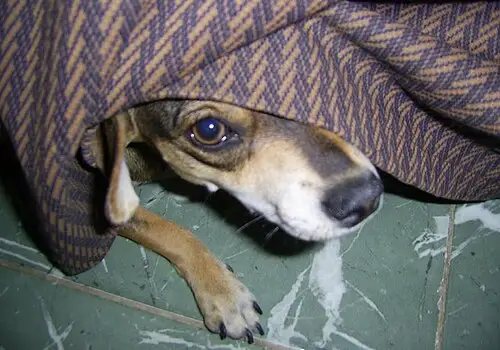
Fear shows up in many ways, from mild to severe. Common signs include trembling, panting, pacing, drooling, whining or barking, and hiding. Some dogs dig at doors or try to escape.
Body language gives more clues. A frightened dog may pin the ears back, show wide pupils, tuck the tail and turn down treats they usually love. If you see these signs, start helping right away rather than waiting to see whether they pass.
Before the noise starts
Dogs that bolt in panic are easier to find with a tag, a microchip and sometimes a tracker, and our guide to GPS trackers versus AirTags explains the options.
A little preparation makes the biggest difference.
- Exercise earlier. Take a long walk or play session before the fireworks begin. Keep your dog on a leash outdoors, even in a fenced yard. Our guide on how much exercise a dog needs can help you plan.
- Check the ID. Make sure the collar tag is current and the microchip is registered with your phone number. Frightened dogs escape from yards and homes, and they can get lost or hit by a car.
- Create a safe space. Choose a familiar room far from the noise, with few windows and a cozy bed. Introduce it before the event so it already feels like home.
- Cover the sound. Layer white noise with another sound, such as calming classical music, a TV or a fan. Close windows and curtains.
- Offer something to do. A frozen stuffed toy, a long-lasting chew or a lick mat gives your dog a job.
- Try any new product early. Test wraps, sound-blocking gear or prescribed medication on a quiet day, so the first time your dog wears or takes it is not the night of the fireworks.
- Stay home if you can. If you cannot, ask a pet sitter your dog knows and trusts to stay with them.
During the fireworks
Stay near your dog and keep your own behavior steady. Sources differ on comforting. The AKC says you can and should comfort a frightened dog, that slow, firm stroking is usually soothing, and that fast, high-pitched fussing can convince a dog that something really is wrong. UC Davis advises against rewarding fearful behavior with extra attention or reassuring words. A calm, quiet presence fits both views, so watch what settles your dog and follow that.
Reward calm behavior with a treat or a gentle stroke if your dog enjoys it. Never punish fear, because it only adds to the stress. Do not take your dog outside once the fireworks have begun, and do not leave a panicking dog shut in a crate unless you can monitor them closely. Some dogs hurt themselves trying to escape.
If your dog's reaction is frantic, try not to take it personally. Fear is an emotional response, not misbehavior.
Calming aids and your vet
Several products aim to take the edge off. Options include snug anxiety wraps, pheromone sprays and diffusers, wearable noise-reducing gear and calming supplements. Results vary from dog to dog, so check with your vet before you try any of them.
For dogs with strong reactions, medication can help, and your vet is the only person who can say whether it suits your dog. Book the appointment well ahead of the event. Ask when to give it, since medication usually works best when it is started before the noise begins, and test it on a quiet day first. For dogs whose fear is severe, a vet may suggest daily medication through the noisy season, with extra medication as needed on the worst nights.
Never share your own medication with your dog or give more than your vet advises. Do not use human sedatives.
Long-term training: desensitization and counterconditioning
Gradual sound training is the long-term approach vets recommend, but it takes patience. The idea is to play a recording of fireworks very quietly while your dog relaxes, then pair the sound with good things.
- Teach a reliable "settle." Reward your dog for lying calmly on a mat. Make sure the cue works before you add sound.
- Start quiet. Play the recording at a volume that does not bother your dog at all, while you reward relaxed posture.
- Raise the volume slowly. Increase it only when your dog stays calm. If fear appears, turn it down and go back a step.
- Practice often. Daily sessions, where you can manage them, make far faster progress than one a week.
- Keep it going. Once your dog is relaxed at full volume, play the sound from time to time to maintain progress.
Start well outside fireworks season. Before you begin, UC Davis suggests checking that it really is the sound that frightens your dog, rather than the sight or smell of fireworks. A recording cannot fully recreate the real event, with its flashes of light, so some dogs still struggle on the night and medication may stay part of the plan. The training can take weeks to months.
After the fireworks
When the noise stops, clean up before your dog goes back outside. Spent fireworks and leftover trash contain chemicals and heavy metals, so clear them from the yard first. If your dog ate anything unusual during the chaos, call your vet, the ASPCA Animal Poison Control Center at (888) 426-4435 or the Pet Poison Helpline at (855) 764-7661 (US; fees may apply). Outside the US, contact your local emergency vet.
When to see your vet or a behaviorist
Get professional help if your dog's fear feels unmanageable, if your dog has hurt themselves while trying to escape, or if progress stalls. A vet can check for medical problems that make noise sensitivity worse, and may refer you to a veterinary behaviorist for a full plan.
For party-night planning, read our guide to New Year's Eve and your dog. If your dog also shakes when there is no noise at all, see our page on shaking in dogs.
Frequently asked questions
Should I comfort my dog during fireworks?
Staying close is fine, but sources differ on how much fuss to make. The AKC says you can comfort a frightened dog and suggests slow, firm stroking, while UC Davis advises against rewarding fearful behavior with extra attention or reassuring words. Either way, stay calm yourself, skip rapid, high-pitched fussing and never scold.
Should I put my dog in a crate during fireworks?
Only if your dog already sees the crate as a safe den and you can stay close. Some dogs panic and hurt themselves when shut in during loud noise, so a quiet room is often the safer choice.
Are calming supplements and wraps safe to try?
Some dogs seem to benefit, but results vary from dog to dog. Check with your vet before you give any product, and never use medication that was prescribed for another pet or person.
When should I start training for next year?
As early as you can, and outside fireworks season. Gradual sound training takes weeks to months of regular practice, so it works best when it begins well before the next celebration.
Sources
- Cornell University College of Veterinary Medicine: Fear of fireworks and thunderstorms
- VCA Animal Hospitals: Treating Fear of Storms and Fireworks in Dogs
- UC Davis School of Veterinary Medicine: Fear of Fireworks
- ASPCA: Managing Pet Anxiety During Fourth of July Fireworks and Other Festivities
- AKC: How to Keep Your Dog Calm During Fireworks
More behavior guides
All guides
Behavior
How Much Do Dogs Sleep? Normal Hours by Age
Most adult dogs sleep 12 to 16 hours a day, and puppies and seniors sleep more. What is normal, what affects it, and th…
Behavior
How to Stop a Dog From Chewing Everything
Find out why your dog chews, then dog-proof, supervise, offer better chews and add exercise. What works for chewing whe…
Behavior
Separation Anxiety in Dogs: Signs and Training Plans
Separation anxiety is panic, not spite. Learn the signs, how to rule out other causes, a step-by-step alone-time plan,…