Health & care · 7 min read
Safe Chews for Dogs: Are Antlers and Bully Sticks OK?
Quick answer
Antlers are not a safe chew, because hard chews can break teeth. Use the bend-and-dent test: if you cannot flex a chew or dent it with your thumbnail, skip it. Bully sticks and rawhide carry blockage, choking and calorie risks, so supervise any chew and ask your vet.
Key takeaways
- Tufts says bones, antlers, cow hooves, yak chews and hard nylon bones are examples to avoid, because breaking a tooth is very likely.
- A safer chew bends or flexes, dents under your thumbnail, or dissolves in water; if it passes none of these, do not buy it.
- Bully sticks are dried bull or steer penis, they hold 9 to 22 calories per inch, and some tested sticks carried bacteria.
- Rawhide, pig ears, bully sticks, bones and tennis balls have all caused blockages, punctures or choking, and no toy is completely safe.
- The VOHC Seal marks dental chews that met the Council's standards for reducing plaque or tartar, based on data the maker submitted.
In this guide
Antlers are not a safe chew for dogs, because hard chews can break teeth. A safer chew is one you can bend, or dent with your thumbnail. Bully sticks and rawhide sit in between: some dogs chew them without trouble, but they carry blockage, choking and calorie risks, so supervise every chew and ask your vet. No chew is completely safe.
What is the quick safety test for any chew?
Use the Tufts test before you buy. Ask three questions:
- Can you bend or flex the chew?
- Can you dent it with your thumbnail?
- Does it dissolve in water?
If the answer is no to all three, Tufts says not to buy it. VCA gives similar advice: choose chews that bend or can be indented with a fingernail. A chew that cannot give at all is hard enough to crack a tooth.
Size matters too. Humane World says to buy toys sized for your dog, because ones that are too small can be swallowed or lodge in the throat. Throw out toys and chews that are breaking into pieces. The FDA advises supervising your dog with any chew or treat, especially a new one.
Are antlers, hooves, bones and hard nylon safe?
No. Tufts says bones of any kind are not recommended, and it lists antlers, cow hooves, Himalayan yak chews and hard nylon bones as examples to avoid. It calls the odds of breaking a tooth on a bone "very high." In one study, up to 63 percent of wild dogs had at least one fractured tooth. VCA agrees that nylon, bones and antlers can fracture teeth.
Bones cause other problems too. Between November 2010 and September 2017, the FDA received about 68 reports involving about 90 dogs, and about 15 of them died, linked to bone treats such as ham bones, pork femur bones, rib bones and "smokey knuckle bones." Problems included blockage, choking, cuts in the mouth or on the tonsils, vomiting, diarrhea and rectal bleeding. This comes from the FDA Consumer Update (2017), which we cite from an archived copy.
Cooked bones from your own plate are no better. Read our pages on cooked bones and turkey bones. A cracked tooth is painful and can lead to the problems on our dental disease page.
Are bully sticks safe?
Bully sticks are dried bull or steer penis (pizzle). They are digestible, but they have downsides. Tufts says they hold 9 to 22 calories per inch, so a 6-inch (15 cm) stick is nearly 100 calories. In a study of 26 sticks, Tufts reports that 1 carried MRSA, 1 carried C. difficile and 7 carried E. coli (Freeman, Janecko and Weese, Canadian Veterinary Journal, 2013).
That means a few simple habits:
- Wash your hands after you handle one.
- Keep them away from very young children, elderly people, pregnant people and anyone with a weakened immune system, since Tufts says these groups should avoid raw animal-based treats.
- Count the calories. PetMD says treats should stay under 10 percent of your dog's daily calories.
- Supervise your dog, and take the stick away once it is small enough to swallow.
VCA lists bully sticks among the chews that have caused blockages, punctures or choking, so a bully stick is not risk-free.
Are rawhide and other edible chews safe?
Rawhide is a choking hazard, so give it only under supervision, and ask your vet which rawhide products, if any, suit your dog (Humane World). VCA says rawhide, pig ears, bully sticks, bones, synthetic toys and even tennis balls have all caused blockages, punctures or choking. It adds that no toy is completely safe.
Opinions on edible chews differ, so there is no single yes or no. Treat them as an occasional, watched treat rather than a daily habit, and skip them if your dog gulps or swallows chunks. If you are unsure, ask your vet. A tennis ball is fine for fetch but not for chewing, according to Humane World, and a chewed-through one should be thrown away.
Do dental chews work, and what is the VOHC Seal?
The VOHC Seal means a product met the Veterinary Oral Health Council's standards for reducing plaque, tartar (calculus) or both, based on data submitted to the Council. The VOHC reviews that data but does not test products itself. You can find accepted dog products at vohc.org.
A seal does not replace brushing. Our guide to brushing your dog's teeth covers the basics. Dental chews also count toward your dog's calories, so include them in the 10 percent allowance.
What are the safer choices?
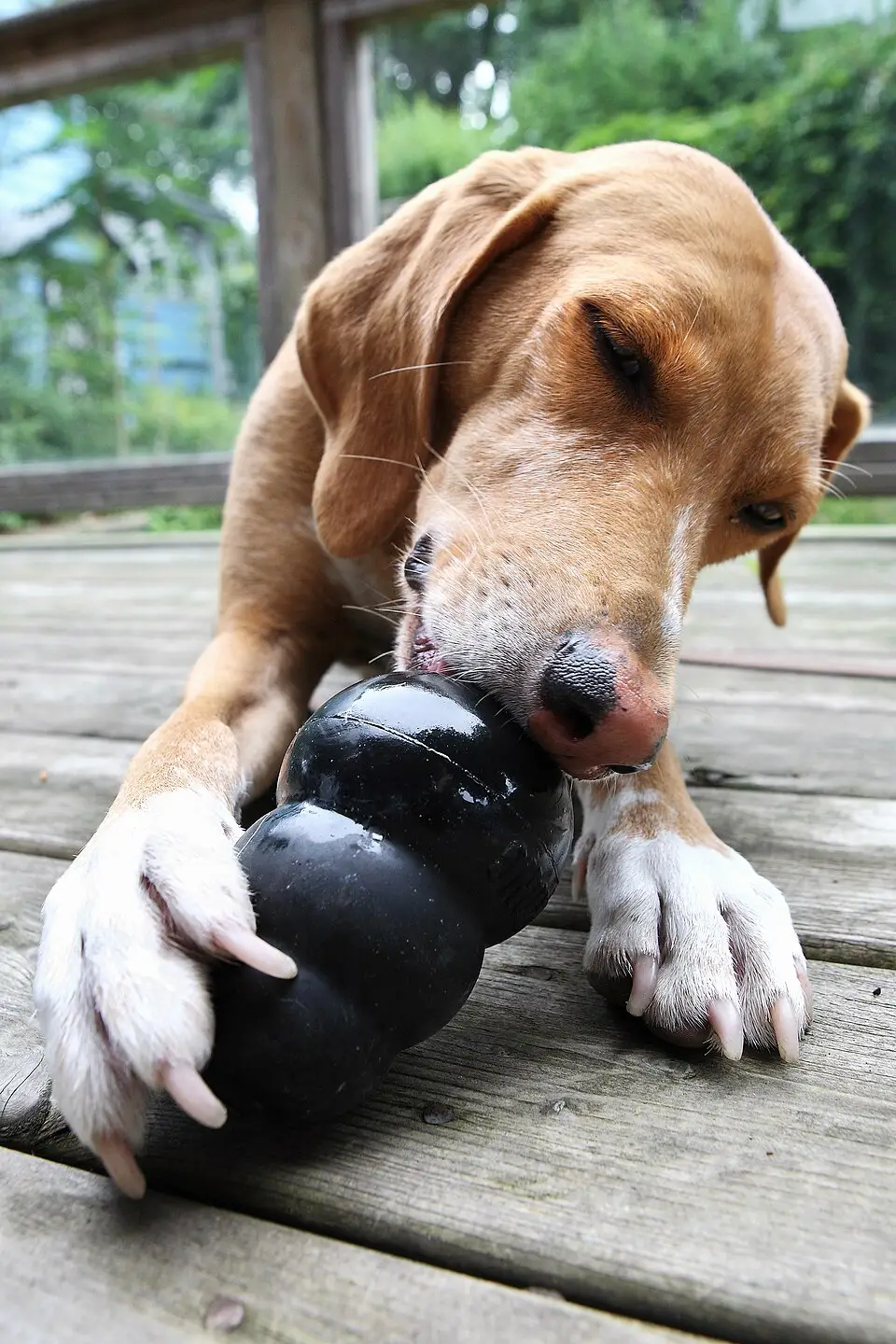
Look for rubber toys and chews that pass the bend-and-dent test and suit your dog's size. Food-dispensing toys and lick mats give dogs something to chew or lick for a long time without a hard surface. Rotate a few toys so they stay interesting.
Check each toy often, and throw away anything cracked or breaking apart. Choose the size for your dog's mouth, not the size of the packaging. If you have a teething puppy, our puppy teething guide lists soothing options, and our guide on how to stop a dog from chewing helps when your dog chews household items.
What are the rules for safe chewing?
- Supervise. The FDA and Humane World both advise watching your dog with any chew, especially a new one.
- Test. Use the bend-and-dent test every time you buy.
- Size it right. Buy chews sized for your dog and remove them when small.
- Count calories. Keep chews and treats under 10 percent of daily calories.
- Skip bones. Avoid bones of any kind, cooked or raw.
- Wash up. Wash your hands after handling bully sticks or other animal-based chews.
When to call your vet
Call your vet if your dog chips or breaks a tooth, gags, vomits, strains to poop or has blood from the rectum after a chew. These can be signs of a cracked tooth, a blockage or an injury.
If your dog is choking, treat it as an emergency and go to an emergency vet right away. Our first aid basics explain what to do while you get help, and our page on vomiting covers when it signals a problem.
Frequently asked questions
Are antlers safe for dogs?
No. Tufts lists antlers among the hard chews to avoid, along with bones, cow hooves, yak chews and hard nylon bones, because they can break teeth. VCA also says nylon, bones and antlers can fracture teeth. A softer, bendable chew is a safer choice.
Are bully sticks safe for dogs?
They are digestible but not risk-free. Tufts says a 6-inch (15 cm) bully stick has nearly 100 calories, and in one study some sticks carried bacteria such as MRSA, C. difficile and E. coli. Wash your hands after handling them, supervise your dog and ask your vet.
Are bully sticks safer than rawhide?
Neither is risk-free. VCA says rawhide, pig ears and bully sticks have all caused blockages, punctures or choking in dogs. Humane World says rawhide is a choking hazard and to ask your vet which products, if any, suit your dog.
What chews do vets recommend?
Vets point to chews that pass the bend-and-dent test, dental chews that carry the VOHC Seal, and rubber toys that suit your dog's size. Tufts and VCA both advise choosing chews you can bend or dent with a fingernail.
Are cooked bones from the table OK?
No. The FDA received about 68 reports of illness linked to bone treats between 2010 and 2017, and Tufts does not recommend bones of any kind. See our pages on cooked bones and turkey bones for what to do if your dog ate one.
How long should a dog chew a bully stick or rawhide?
No source gives a time limit. Supervise your dog, and take the chew away once it is small enough to swallow. Throw away any toy that is breaking into pieces.
Sources
More health & care guides
All guides
Health & care
Diarrhea in Dogs: Common Causes and When to Worry
Mild diarrhea in a bright, eating dog often settles in a couple of days. Learn the likely causes, safe home care and th…

Health & care
Vomiting in Dogs: When to Wait and When to Call the Vet
One bout of vomiting in an otherwise bright dog can often be watched at home. Learn the red flags that mean call the ve…